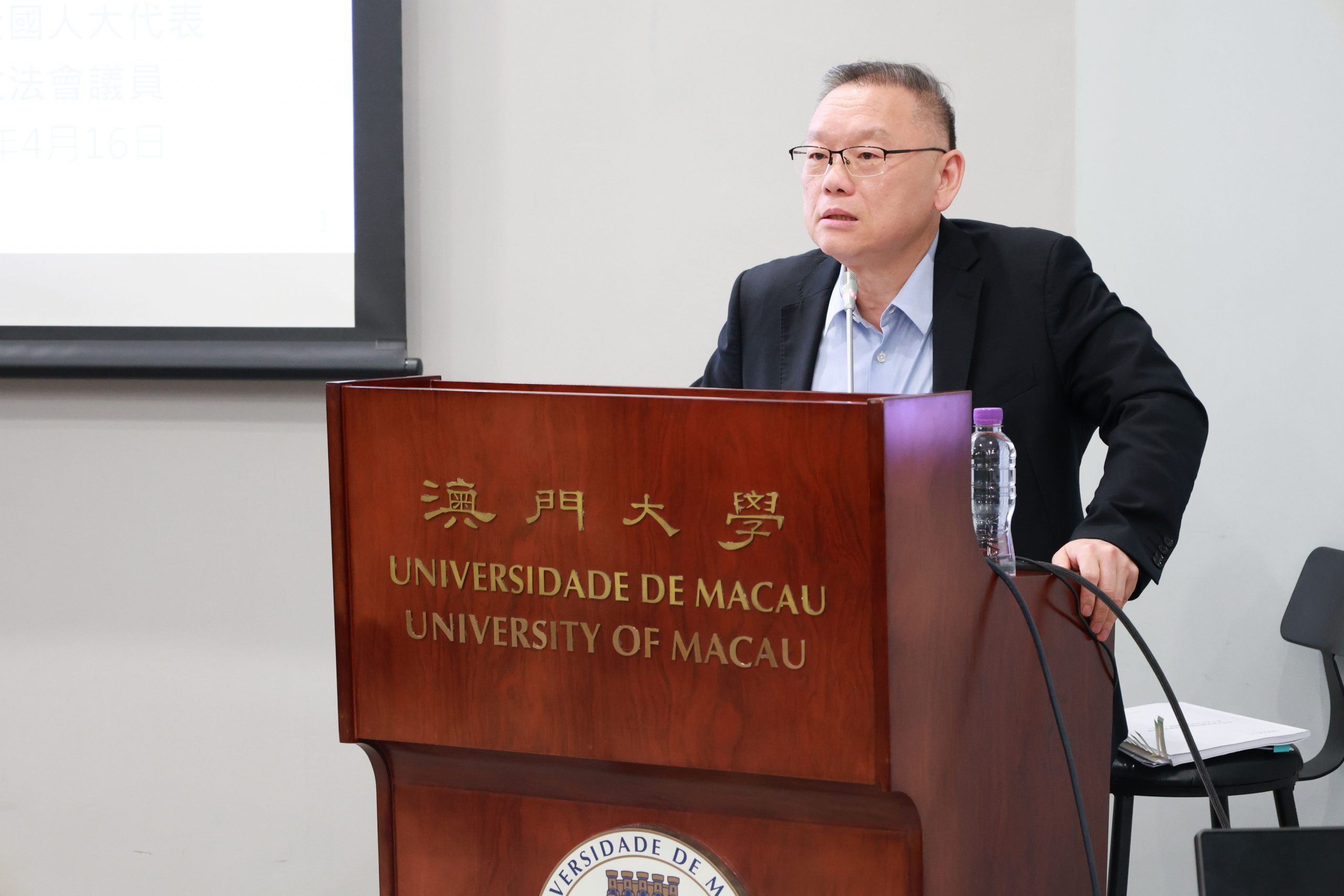
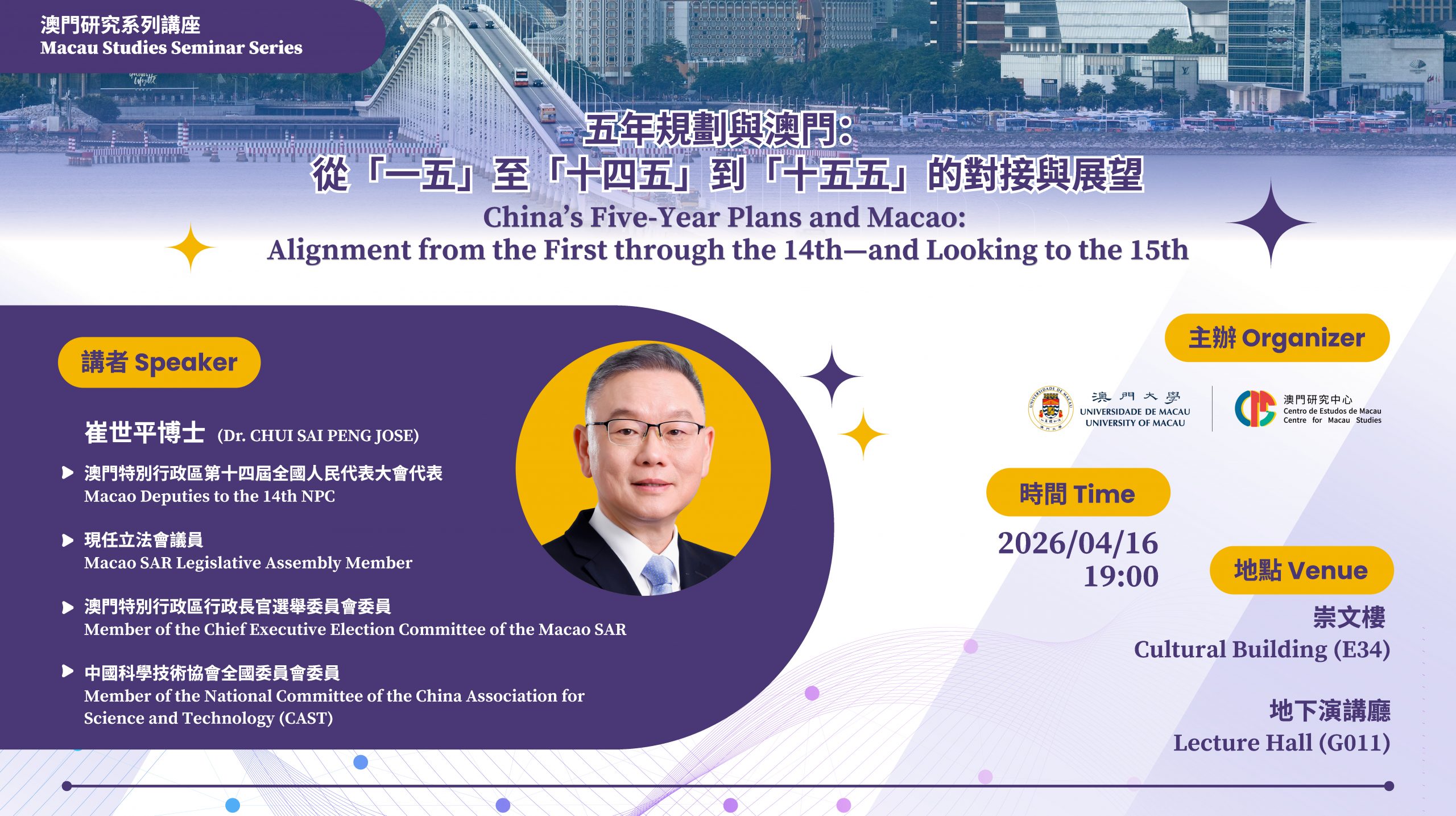
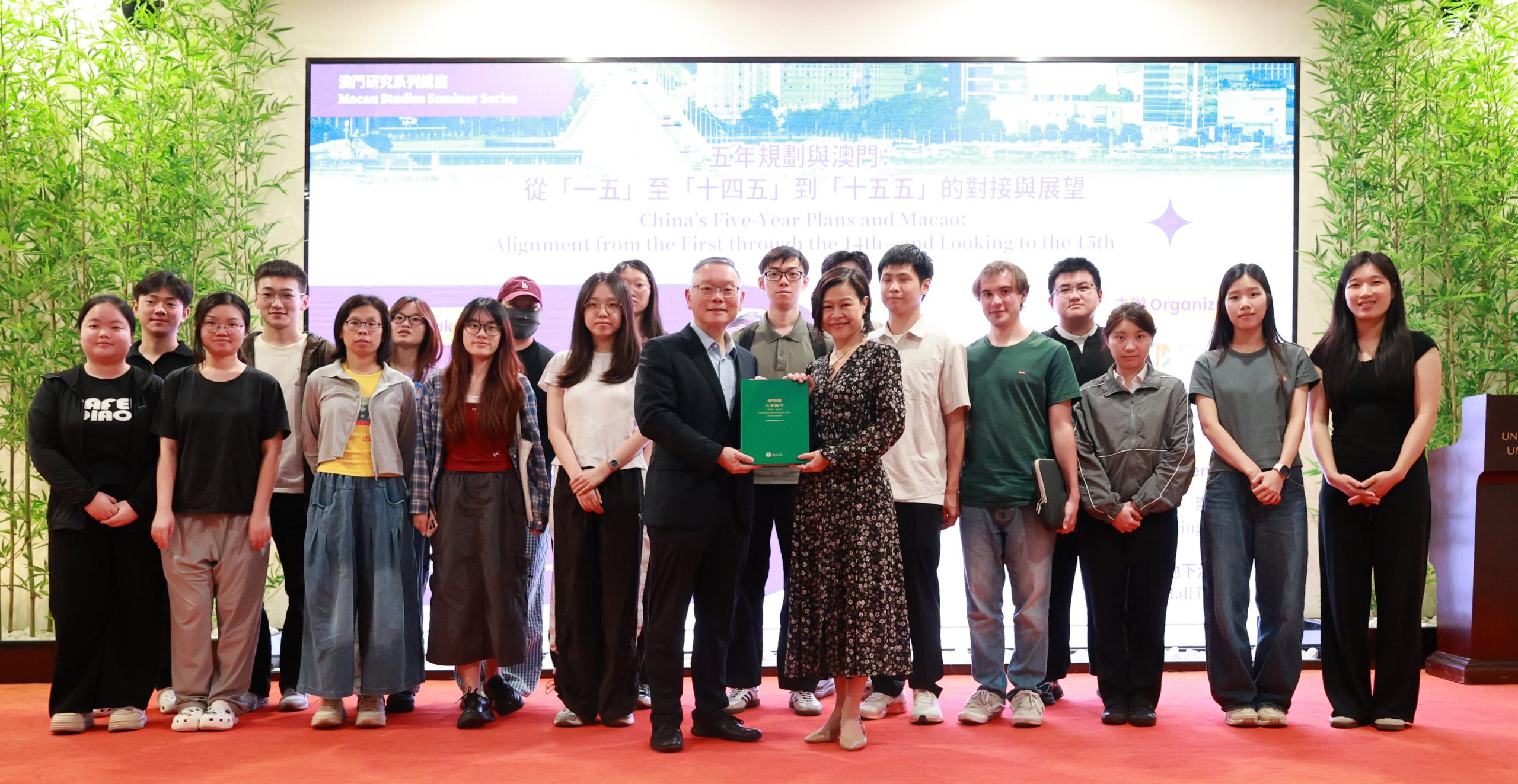
The Centre for Macau Studies (CMS) of the University of Macau (UM) held a “Macau Studies Seminar Series” lecture on 16 April at the Cultural Building (E34). The seminar featured Dr. Chui Sai Ping, Deputy to the 14th National People’s Congress of the Macao SAR and Member of the Macao SAR Legislative Assembly, who delivered a lecture entitled “China’s Five-Year Plans and Macao: Alignment from the First through the 14th—and Looking to the 15th.” The lecture examined the historical evolution, key objectives, and contemporary relevance of China’s Five-Year Plans, with particular attention to their implications for Macao’s development.
During the lecture, Dr. Chui noted that since the implementation of the first Five-Year Plan in 1953, China has continuously relied on successive Five-Year Plans to coordinate economic and social development, guiding the country through different stages of growth. As a key outline for national development, the Five-Year Plan has played a crucial role in setting strategic directions, coordinating major projects, and allocating resources across different historical periods.
He systematically reviewed the evolution of China’s Five-Year Plans from the First Plan to the 14th Plan, outlining the major development goals, key projects, and indicator systems of each stage. From perspectives such as economic growth drivers, innovation capacity, industrial restructuring, livelihood protection, and green development, he analysed the policy priorities of successive Five-Year Plans. By comparing core indicators—including total economic output and per capita levels across phases—he illustrated the structural characteristics and transformation paths associated with different stages of national development.
Focusing on Macau, Dr. Chui further examined the key contents and development objectives of the Macao SAR’s planning framework, highlighting differences between Macau and the mainland in terms of development pace, industrial structure, and structural adjustments. He also discussed areas where greater alignment and coordination could be pursued between the two sides. He emphasised that in the process of integrating into the national development strategy, Macau should make good use of the policy guidance and opportunities provided by the Five-Year Plans, continue promoting appropriately diversified economic development, foster emerging and future industries, and further optimise its economic structure to support long-term and sustainable development.