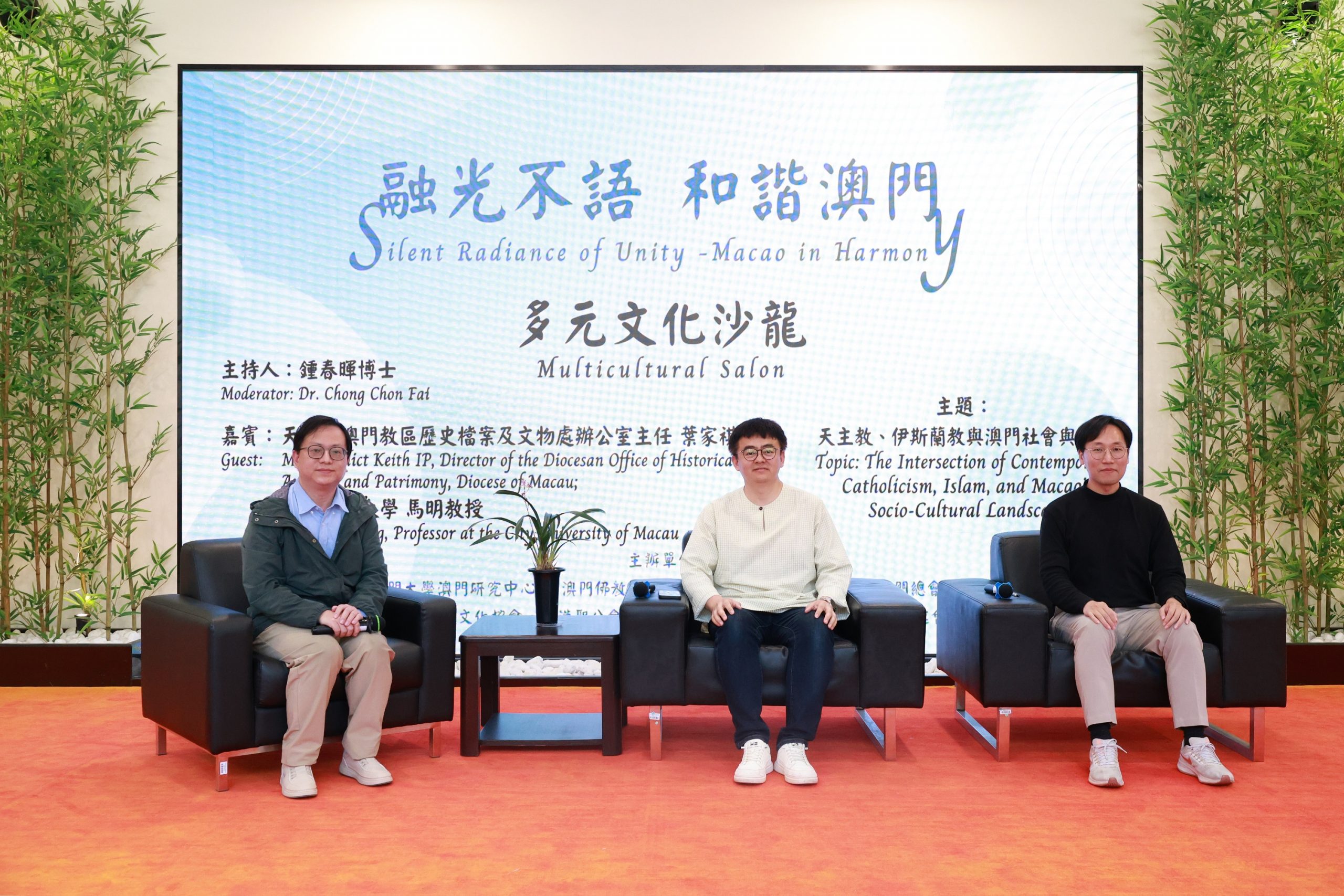
The second session of the “Silent Radiance of Unity – Macao in Harmony” Multicultural Salon, jointly organized by the Centre for Macau Studies (CMS) of the University of Macau (UM) and the Buddhist Association of Macau, Macao Taoist Association, The Spiritual Assembly of the Bahá’ís of Macau, Macao Catholic Culture Association, Hong Kong Sheng Kung Hui Missionary Area of Macau, and the Macau Islamic Cultural Exchange Promotion Association, was held on the morning of 12 March at UM Cultural Building. Centered on interfaith dialogue, the session featured Mr. Ip Ka Kei, Director of the Diocesan Office of Historical Archives and Patrimony, Catholic Diocese of Macao, and Prof. Ma Ming, City University of Macau, as keynote speakers. The dialogue explored the historical development, faith practices, and social engagement of Catholicism and Islam in Macao, attracting participation from university members and the general public.
Mr. Ip shared the Catholic faith experience in Macao over more than four centuries, centering his discussion on the values of love and peace. He noted that since its establishment in Macao, the Catholic Church has been actively involved in community care and social services. Using the Mong Ha Parish as an example, he highlighted how the presence of Saint Francis Xavier’s Church, alongside nearby elderly homes and kindergartens, forms an integrated community space that reflects the close integration of faith and everyday life.
Prof. Ma Ming introduced the core teachings of Islam by explaining the Five Pillars of Muslim practice—profession of faith, prayer, fasting, almsgiving, and pilgrimage—providing participants with a clearer understanding of Islamic beliefs and daily practices. He noted that Macao’s Muslim community is mainly composed of Chinese, South Asian, and Southeast Asian members. Although relatively small and low-profile, the community has established its presence through everyday livelihoods such as operating food businesses, contributing to Macao’s multicultural landscape.
During the dialogue session, both speakers agreed that religion plays a positive and constructive role in social development, and that interfaith exchanges help foster mutual understanding, inclusiveness, and harmony. In her concluding remarks, Prof. Lam Iok Fong, Director of CMS, noted that it is particularly valuable for a small city like Macao to sustain long-standing religious harmony and rational dialogue. She encouraged students to continue engaging with different religious communities and to explore the core values behind diverse belief systems, in order to better appreciate the spirit of “a small city with great love” embodied by Macao.