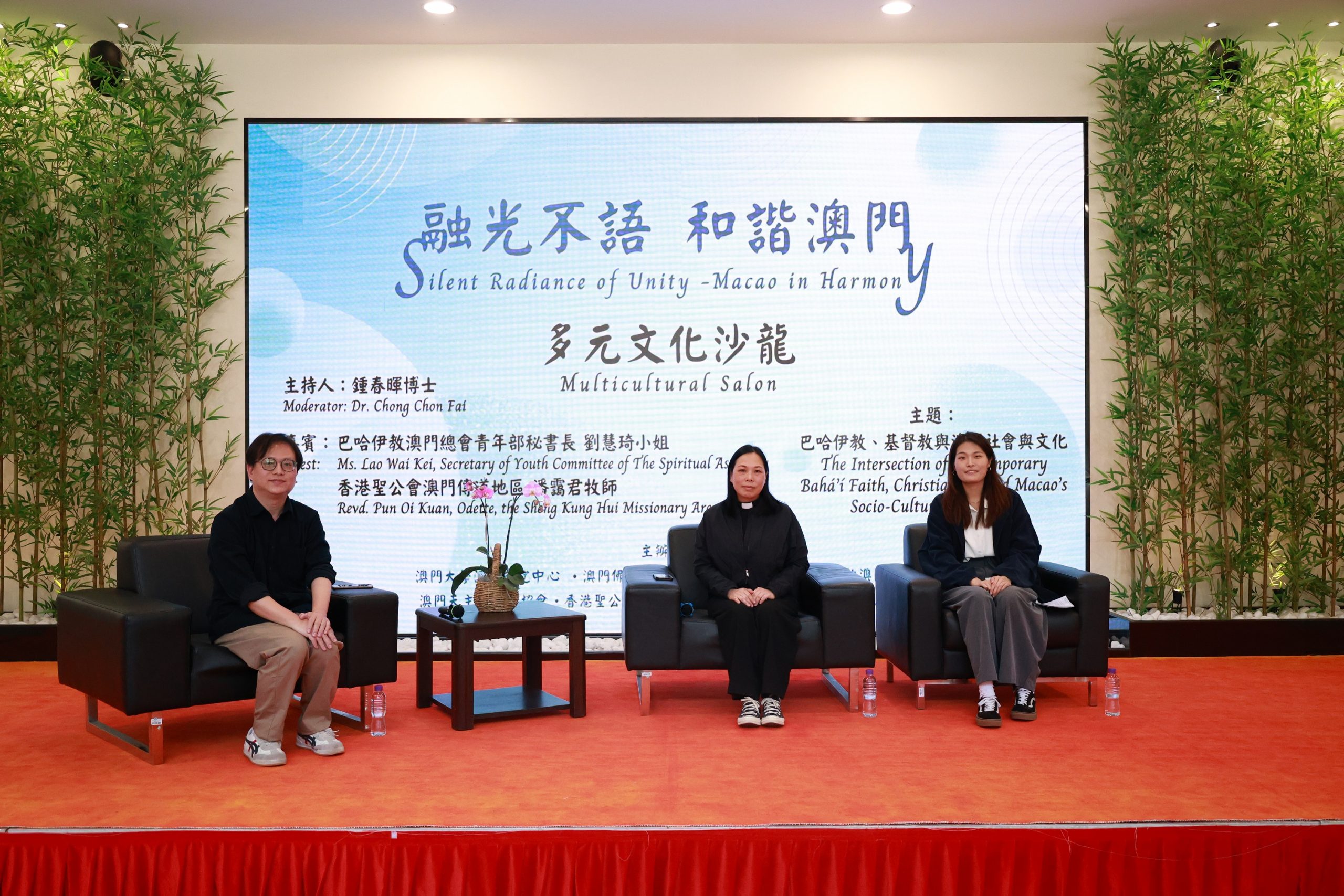
The third session of the “Silent Radiance of Unity – Macao in Harmony” Multicultural Salon, jointly organized by the Centre for Macau Studies (CMS) of the University of Macau (UM) and the Buddhist Association of Macau, Macao Taoist Association, The Spiritual Assembly of the Bahá’ís of Macau, Macao Catholic Culture Association, Hong Kong Sheng Kung Hui Missionary Area of Macau, and the Macau Islamic Cultural Exchange Promotion Association, was held at noon on 19 March at UM Cultural Building. Centered on in-depth interfaith dialogue, the session featured Pun Oi Kuan, the Revd Odette of the Sheng Kung Hui Missionary Area of Macau and Lao Wai Kei, Secretary of Youth Committee of the Spiritual Assembly of the Bahá’ís of Macau. The discussion focused on social practices, core values, and youth development approaches of Christianity and the Bahá’í Faith in Macao, attracting participation from university members and the general public.
Reverend Pun shared the core perspectives of Christianity from the Anglican tradition, noting that the Church upholds the principle of respecting the dignity and uniqueness of every individual without categorization or hierarchy. She introduced the “three-pronged” model practiced by the Anglican Church in Macao, which closely connects religious institutions, schools, and social services. Through diversified services, the Church contributes to community care and social well-being. She also shared practical experiences of interaction and cooperation with other religious groups, illustrating Macao’s long-standing tradition of interfaith harmony. Ms. Lao elaborated on the core values of the Bahá’í Faith, emphasizing that beliefs should be translated into action. She explained that through systematic learning and service at the individual, family, and community levels, Bahá’í communities support participants’ spiritual and intellectual growth, while contributing to the overall well-being of society.
Regarding youth development, Reverend Pun emphasized that accompaniment is at the core of nurturing young people. She noted that faith communities should engage with youth through companionship and guidance rather than discipline, helping them recognize hope in life, understand their connection to the wider world, and build meaningful values. Ms. Lao shared that the Bahá’í community fosters youths’ independent thinking and sense of social service through continuous learning, practical action, collective consultation, and reflection, guiding them to become positive contributors to society.
In her concluding remarks, Prof. Lam Iok Fong, Director of CMS, expressed gratitude to the participating religious organizations for their long-term commitment to interfaith dialogue. She noted that the salon series, through authentic sharing and exchange, has deepened understanding of religion as a field that embodies both humanistic warmth and academic value. The dialogue not only enhanced mutual understanding and respect among participants, but also offered valuable insights and practical references for fostering cultural and religious harmony in Macao.